Nature-based mitigation crucial to combat climate crisis: Researcher Garza
Directorate of Social Communication, 26/May/2024
UAEH Newsletter No. 252
*The last federal report from the Ministry of Health informed that during the current hot season 48 people died due to high temperatures, in Hidalgo there are two deaths.
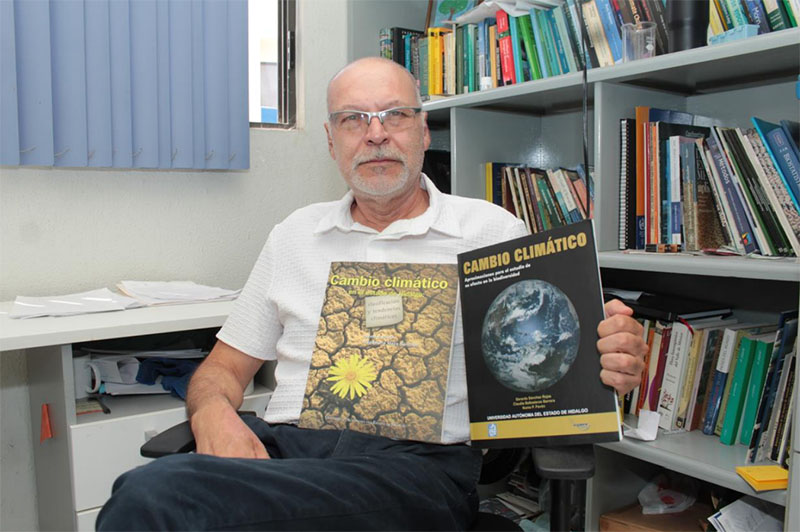
Pachuca de Soto, Hidalgo. - The preservation of natural ecosystems, recovery of degraded systems and reforestation under planning and management by experts, are some low-cost and natural strategies that can be implemented to adapt to the high temperatures currently occurring in the country, said Numá Pompilio Pavón Hernández, research professor of the Academic Area of Biology at the Autonomous University of the State of Hidalgo (UAEH).
"What we are experiencing these weeks with the heat waves, is a clear warning of what awaits us in the not too distant future, just because of climate change," said climatologist Garza, who emphasizes that the current situation that is being experienced globally with the increase in temperature, are the first signs of what the scientific community, working on this issue, has been warning for a long time about the importance of mitigation actions, conservation of ecosystems and reducing emissions of greenhouse gases.
The specialist in ecology and climate change emphasized that reforesting urban areas is a good option to mitigate high temperatures, but there must be advice from specialists in botany and soil science, to select the most optimal specimens according to the conditions of the area to be served.
For this reason, he recommends to the population of the Pachuca area to plant trees such as pirul, pear trees, palms, some types of magnolia, mesquites, white cedars, as well as some species of pine as long as they have a good humidity and good soil, but they should avoid the "pine of the fools" an Australian type that degrades soils. "Adopt that tree, don't just plant it, take care of it, go there frequently, water it and watch it grow" stressed the climatologist.
Dr. Numa Pavón clarifies that the ideal would be to opt for clean energies, however, the technology to develop them is far behind, in addition to the fact that the construction of solar or wind farms also generates carbon emissions, therefore, the most viable option is to generate inexpensive mitigation-adaptation actions based on nature.
"That is why it is urgent to conserve what we have of natural ecosystems, ecologically restore degraded systems, recover vegetation, which has the ability to capture carbon from the atmosphere, serves as a buffer or temperature buffer and generates water," said the UAEH researcher.
The academic from the Institute of Basic Sciences and Engineering (ICBI) emphasized that it is time for authorities and decision makers to start implementing stronger and more tangible actions to mitigate climate change and not wait for millions of deaths or more refugees due to the climate crisis, as is currently happening in Africa, Asia and the Pacific Islands.



Share in: